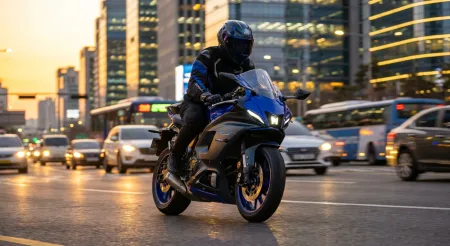
 Reviews
Back to Home
Reviews 16 min read time 2 viewsJul 26, 2026(Updated on Aug 07, 2026)
Yamaha MT-03 2026: Will the Real Cost Per Km Break You?
The 2026 MT-03 promises sportiness, but hides a devastating cost per km. Check real fuel consumption, OTR price, and maintenance before buying.
The Illusion of the Affordable Sport Bike and the Cost-Per-Kilometer Trap
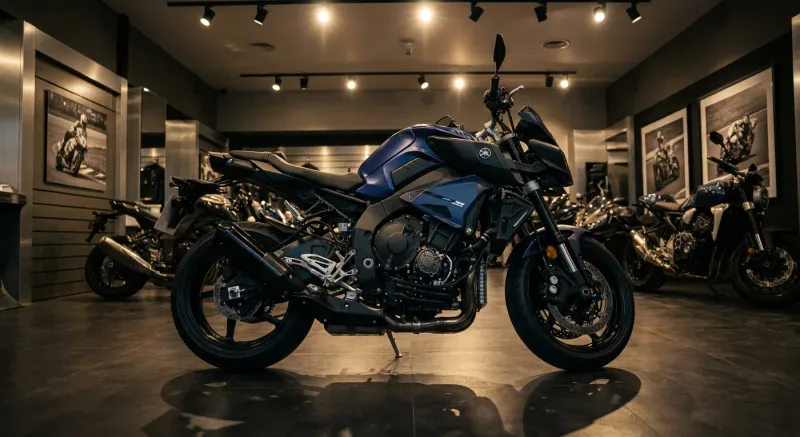
The secret cost per kilometer of the 2026 MT-03 is a perfect trap. When you set eyes on it in the dealership showroom, the scene is mesmerizing: the aggressive front end in true Dark Side of Japan style, the sharp angular lines, and that deep rumble of the twin-cylinder engine purring on the lift stand. For those looking to step up from urban 150cc or 250cc bikes, the initial impression is that you're standing in front of the best value for money on the planet. After all, you get big-bike looks for a price that seems to fit into your monthly budget without major strain.
But pull up a chair at the workshop counter and let's talk biker to biker. What the shiny showroom and colorful brochures don't tell you is that buying the bike is just the entry fee to a very exclusive club. From the moment the front wheel touches the street asphalt, the real-world bill starts ticking at a speed very different from the digital dash. If you dive in headfirst without doing the precise math, you risk falling into the classic motorcycle financing trap, where the monthly payment fits your wallet, but invisible running costs end up parking the bike in the garage halfway through the month.
The goal of this dossier is to lay it straight without corporate nonsense. We will open the black box of running costs for the 2026 Yamaha MT-03 Connected, calculating cent by cent the real-world fuel consumption in heavy traffic and on the highway, the hit from mandatory service inspections to keep the 4-year warranty, and the parts bottlenecks that usually cause headaches at independent repair shops. No marketing fluff—just the raw facts from someone who knows the smell of gasoline and the reality of the road.
List Price vs. Dealership Reality: How Much Does 'On the Road' Really Cost?
The first major illusion for the 2026 MT-03 buyer begins right on the manufacturer's website. The Manufacturer's Suggested Retail Price (MSRP) shown in official campaigns ranges between R$ 33,990.00 and R$ 34,190.00 (reaching R$ 34,390.00 for units registered in the 2027 transition batch). However, that figure is just a theoretical baseline, ignoring the logistical variables that turn the screen number into the exact amount charged on a check or bank transfer inside the dealership.
When you ask for a final quote in person, freight and official factory transit insurance are added to the math, adding between R$ 1,544.00 and R$ 1,693.00. With local ICMS tax adjustments, the adjusted list price rises to R$ 36,083.00. However, the actual market in the Southeast operates with significant variations based on inventory and regional competition. In Greater São Paulo, you can find promotions for zero-mileage units for R$ 32,990.00 cash, while in upcountry São Paulo state (such as Campinas) the going price jumps to R$ 34,990.00. In Rio de Janeiro, authorized dealer listings average R$ 33,900.00, while in Minas Gerais the price including freight and local fees easily reaches R$ 35,000.00 to R$ 37,000.00 "On the Road".
This is precisely where understanding official valuation tables (like FIPE in Brazil) comes in handy as a bargaining tool. With the FIPE benchmark for the 2026 MT-03 Connected set at R$ 32,328.00, the buyer holds a valuable trump card. Dealerships with full lots tend to yield when confronted with these numbers. The golden rule is to demand an itemized invoice separating the actual cost of the bike from the freight charge. If freight exceeds the R$ 1,693.00 specified by the factory, the dealer is hiding a hidden markup. Use the market valuation to negotiate free full registration or the inclusion of initial services without charge for consumables.
A Thirsty Beast: Real Consumption in the City, Highway, and High RPMs
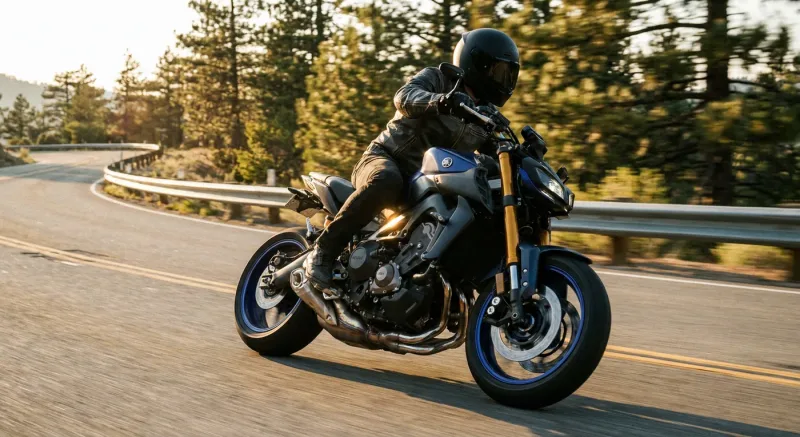
If there is one area where the 321 cc, 41.3 hp inline twin-cylinder engine accepts no compromises, it's at the gas pump. Engineered to deliver peak power at a high 10,750 rpm and maximum torque of 3.0 kgfm at 9,000 rpm, this powertrain craves high revs. The practical result is a heavy fuel bill for anyone expecting the economy of a traditional small-displacement commuter bike.
In heavy urban stop-and-go traffic, squeezing through narrow lanes and going traffic light to traffic light, the MT-03 posts harsh averages between 18 km/l and 20 km/l (42–47 mpg US). On smoother urban expressways, riding gently, you can stretch that figure to 22 km/l to 26 km/l (51–61 mpg US). On the highway, cruising comfortably in 6th gear between 90 km/h and 110 km/h (55–68 mph), consumption stabilizes between 21 km/l and 24 km/l (49–56 mpg US). However, if the rider gets excited, twists the throttle, and rides in the aggressive sport zone above 9,000 rpm, fuel economy plummets mercilessly down to 15.8 km/l (37 mpg US). To check all technical details of this dynamic performance, consult our detailed review on MT-03 2026 fuel consumption and pricing.
With this thirsty reality, the 14.2-liter (3.75 gal) fuel tank requires careful planning so you don't end up stranded. Out of the total volume, 3.0 liters (0.79 gal) are reserved strictly for the danger zone (reserve). In practice, assuming a mixed combined average of 20 km/l, theoretical maximum range is 284 km (176 miles). However, to prevent overheating and pulling debris into the fuel pump by running dry, the safe, usable range before the low-fuel warning light turns on is between 250 km and 310 km (155–192 miles).
Scheduled Maintenance: The Price of Keeping the Warranty Stamp
Yamaha offers a lengthy 4-year warranty for the 2026 MT-03, an undeniable advantage over competitors. However, this loyalty contract requires the owner to strictly follow the brand's Fixed Price Service Program schedule, making mandatory stops every 5,000 km or 6 months—whichever comes first—after the initial 1,000 km checkup.
The service cost scale shows a financial progression you must account for in your annual budget:
- 1,000 km / 6 months: R$ 156.00 to R$ 360.00 (Free labor, oil and filter replacement);
- 5,000 km / 12 months: R$ 126.00 to R$ 366.00 (Free labor, oil replacement and inspections);
- 10,000 km / 18 months: R$ 660.00 to R$ 948.00 (Paid labor; includes spark plugs and injection sync. In major hubs like São Paulo, the cost reaches R$ 1,026.00);
- 15,000 km / 24 months: R$ 732.00 to R$ 780.00 (Air filter and brake fluid replacement);
- 20,000 km / 30 months: R$ 696.00 to R$ 1,092.00;
- 25,000 km / 36 months: R$ 312.00 to R$ 558.00;
- 30,000 km / 42 months: R$ 1,122.00 to R$ 1,380.00 (Deep general overhaul of consumables).
For riders who prefer performing preventive maintenance outside the authorized network after the warranty period or need to replace quick-wear consumables day-to-day, genuine parts counter prices demand attention. A liter of Yamalube 10W40 semi-synthetic oil costs R$ 56.91. A basic oil change kit containing genuine oil and filter costs R$ 296.97. Meanwhile, the dry air filter element costs R$ 121.51, a set of genuine rear brake pads is quoted at R$ 251.66, and a simple clutch cable doesn't go for less than R$ 189.72 at authorized auto parts retailers.
The Mechanic's Breakdown: Recall History and Recurring Defects
The perspective of mechanics working on these bikes daily in independent repair shops reveals details that owner manuals omit. Although the 2026 MT-03 Connected has no open active recalls with consumer protection agencies to date, the lineage of this 321cc engine carries a known history. In previous generations, Yamaha had to issue recall campaigns to replace the radiator hose (risk of coolant leakage on 2016-2019 models) and fix the gear shift selector spring (2017-2018 models).
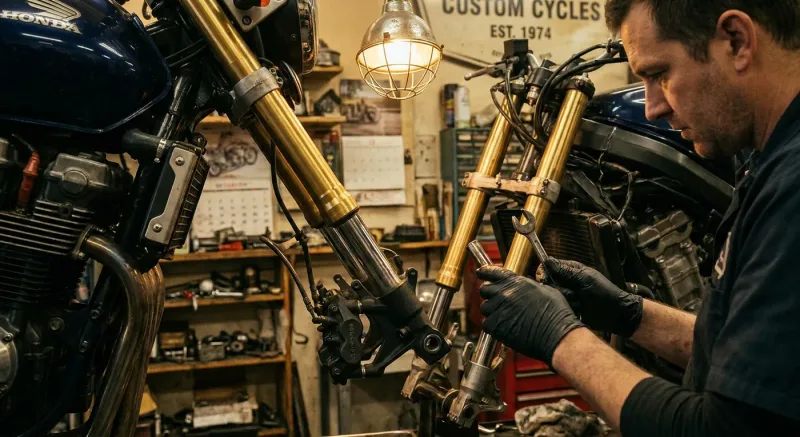
On the current generation, mechanics point out chronic wear issues that frequently appear on the lift. The most complained-about flaw is the drying and cracking of the plastic rear brake fluid reservoir cup: due to its exposed position to engine heat and sunlight, the component becomes brittle and crumbles prematurely. Another chronic bottleneck is the vulnerability of the fork seals on the KYB inverted front suspension. In cities with damaged, potholed pavement, any harsh impact or dirt buildup on the fork stanchions leads to internal oil leaks, requiring early repair.
"The MT-03 is a mechanical rocket, but it requires the owner to be meticulous with maintenance. If you neglect chain lubrication every 500 km, the original drive chain develops excess slack in less than 10,000 km. Another important detail is watching out for noise in the rear wheel, as play in the wheel bearings and seals after riding in heavy rain are constant complaints here at the shop." — Technical Diagnosis from a Specialized Workshop.
In addition, accelerated wear of the final drive kit (chain, front and rear sprockets) and occasional reports of play in the rear wheel spacer and bearings reinforce that the MT-03 does not tolerate the neglected maintenance common to smaller commuter bikes. Anyone who wants one in their garage needs to approach routine care with big-bike discipline.
Dueling Category: MT-03 vs Twister 300, Z400/Z500, and Duke 390
When you put the 2026 Yamaha MT-03 on the comparison table with its direct competitors, it becomes clear how engineering concepts and price positioning diverge. If you are upgrading from a smaller bike and considering an urban option like the Honda CB 300F Twister, you must understand that the spec sheet comparison is a complete blowout. The Twister puts out 24.7 hp from its single-cylinder engine, while the MT-03 pushes 41.3 hp to your back once revs pass 10,000 rpm. There is no comparison on the highway: Yamaha's twin-cylinder engine easily outperforms its rival in acceleration, roll-on power, and top speed, offering sport-tuned chassis performance with a 37 mm KYB upside-down fork and Y-Connect smartphone integration that place Yamaha's naked bike on a much higher shelf.
Stepping up to compare against Kawasaki's mid-range twin-cylinder models, such as the Z400 and the new Z500, the fight shifts, but wallet considerations take over. The green brand's naked bikes offer slightly higher horsepower (48 hp to 51 hp), but charge a steep premium for it. At dealerships, the MT-03 costs on average R$ 3,000 to R$ 5,000 less than Kawasaki's Z line. Beyond the lower purchase price, the MT-03, with its 169 kg wet weight and 780 mm seat height, maneuvers much more nimbly through daily traffic lanes—not to mention Yamaha's dealership network, which is infinitely larger and offers spare parts at far less intimidating prices.
Finally, looking at the KTM 390 Duke, the MT-03's biggest advantage lies in mechanical engine smoothness. The Austrian bike's high-compression single cylinder delivers 44 hp with plenty of low-rpm punch, but vibrates uncomfortably during continuous city riding or long highway stretches. Yamaha's parallel-twin engine runs with unmatched smoothness, causing far less arm fatigue for the rider. Furthermore, Yamaha's scheduled maintenance costs (ranging from R$ 400 to R$ 600) are nearly half the service costs demanded by KTM, and the MT-03 still holds top resale value awards in its class, with only 8.4% depreciation in the first year.
Total Cost of Ownership (TCO): The Final Bill for 12,000 km per Year
Treating the purchase of a 321cc motorcycle solely by the monthly loan payment or the cash invoice price is the single biggest mistake buyers make when entering the mid-range segment. To operate a 2026 Yamaha MT-03 responsibly for a full year, assuming a standard mileage of 12,000 km (7,450 miles, or 1,000 km/month), running expenses require sharp planning. When combining fixed mandatory costs with consumable operating supplies, the final figure can shock those accustomed to 150cc bike maintenance.
To start calculating in Southeastern states (São Paulo, Rio de Janeiro, and Minas Gerais), where the annual vehicle property tax (IPVA) for motorcycles is 2%, the tax based on the FIPE value of R$ 32,328.00 ranges around R$ 646.56 to R$ 678.00. Add to this bill the fixed state registration fee of R$ 160.00 and indispensable comprehensive insurance (covering collision, theft, and robbery). For an average urban rider profile around 30 years old, comprehensive insurance won't cost less than R$ 2,150.00 annually in major metropolitan areas. Riding a bike so targeted in the spare parts market without insurance is asking to lose your asset overnight.
The biggest daily expense, however, is fuel consumption combined with preventive maintenance. To cover 12,000 km achieving a realistic combined average of 20 km per liter (at R$ 6.00 per liter), you will burn exactly 600 liters of fuel, totaling R$ 3,600.00 annually in gas alone. Factor in another R$ 2,250.00 for dealer scheduled service plans, regular Yamalube oil changes every 2,500 km, a pair of radial tires, and drive chain kit wear. The final bill to keep the MT-03 running reaches R$ 8,838.00 per year. This means the bike demands a clean net income of R$ 736.50 per month just to exist in your garage—before paying a single cent toward loan installments.
Garage Verdict: Is It Worth It or Will It Break Your Bank Account?
👍 Pros / Strengths
- High Fuel Consumption: Can drop to 15.8 km/l (37 mpg US) when pushed hard at high revs.
- Passenger Comfort: Elevated, thin rear pillion seat makes long trips very uncomfortable for passengers.
- No Wind Protection: Direct wind blast to the rider's chest at speeds above 110 km/h (68 mph).
- Tall Rider Ergonomics: Riders over 1.80 m (5'11") will feel their knees excessively bent.
Frequently Asked Shop Questions (Straight Talk)
What is the actual 'On the Road' price for the 2026 Yamaha MT-03 including freight?
The factory's suggested list price starts at R$ 33,990.00 (excluding freight). However, adding official freight and transit insurance (between R$ 1,544.00 and R$ 1.693,00), the national list price consolidates at R$ 36,083.00. At dealership counters in the Southeast, actual on-the-road prices for registered bikes range from R$ 32,990.00 during cash promotions up to R$ 36,990.00 in upcountry dealerships.
How many kilometers per liter does the 2026 Yamaha MT-03 get in the city and on the highway?
In everyday mixed riding, it gets around 20 km/l (47 mpg US). In city riding with heavy stop-and-go traffic, consumption ranges between 18 km/l and 20 km/l (42–47 mpg US); on open urban avenues, it can reach 26 km/l (61 mpg US). On the highway cruising at a steady 90 km/h to 110 km/h in 6th gear, averages range from 21 km/l to 24 km/l (49–56 mpg US). Aggressive riding above 9,000 rpm drops fuel economy to 15.8 km/l (37 mpg US).
Does the 2026 Yamaha MT-03 have chronic defects or active recalls?
There are no open recalls for 2026/2027 models. Historically, units manufactured between 2016 and 2019 underwent official recalls for radiator hoses and shift selector springs. On the current model, owners and repair shops report premature drying of the plastic rear brake fluid cup due to sun exposure, accelerated fork seal wear on poor pavement, and the need for frequent chain lubrication every 500 km.
What is the average IPVA tax and insurance cost for the MT-03 in SP, RJ, and MG?
With the standard 2.0% tax rate applied to the FIPE benchmark of R$ 32,328.00, annual vehicle tax (IPVA) averages R$ 646.56 (up to R$ 678.00 depending on the purchase invoice). Full comprehensive insurance for riders over 28 years old ranges between R$ 2,150.00 and R$ 2,300.00 annually. For young riders under 25 in higher-risk zones, full coverage can exceed R$ 3,500.00.
Is it worth buying the 2026 MT-03 for work, or is it strictly for leisure?
Straight talk: it is not worth buying for daily commercial work, delivery gigs, or heavy commuting. High fuel consumption and rapid wear on tires and drive chain kits make the cost per kilometer commercially unviable. The MT-03 is a machine built for leisure, weekend rides, and short lifestyle commutes for those seeking performance and fun.
Confirmed Spec Sheet: 2026 Yamaha MT-03 Connected
Check below all official technical data and numerical specifications confirmed by the manufacturer for the 2026 twin-cylinder naked lineup:
Official Technical Specifications - 2026 Yamaha MT-03
- Engine: Parallel-twin, 4-stroke, DOHC, 8 valves, liquid-cooled, 321 cc
- Bore x Stroke: 68.0 mm x 44.1 mm (Compression Ratio: 11.2:1)
- Maximum Power: 41.3 hp at 10,750 rpm
- Maximum Torque: 3.0 kgfm at 9,000 rpm
- Fuel System: Electronic Fuel Injection (Gasoline)
- Transmission: 6-speed with assist & slipper clutch
- Front Suspension: 37 mm KYB inverted fork, 130 mm travel
- Rear Suspension: Monocross with preload-adjustable shock, 125 mm travel
- Front Brake: 298 mm hydraulic single disc with ABS
- Rear Brake: 220 mm hydraulic single disc with ABS
- Front Tire: 110/70 R17 M/C (54H) Metzeler/IRC
- Rear Tire: 140/70 R17 M/C (66H) Metzeler/IRC
- Overall Length: 2,090 mm | Width: 755 mm | Seat Height: 780 mm
- Wheelbase: 1,380 mm | Minimum Ground Clearance: 160 mm
- Wet Weight: 169 kg (373 lbs)
- Fuel Tank: 14.2 Liters / 3.75 gal (3.0 Liter / 0.79 gal Reserve)
- Connectivity: Blackout LCD Panel with Y-Connect App via Bluetooth
Fulfilling the garage dream of twisting the throttle on a 41.3-horsepower twin-cylinder naked is one of the most rewarding experiences the two-wheeled world can offer. However, keeping that passion alive without turning it into a financial nightmare requires staying grounded: calculate daily running costs, budget for preventive maintenance before purchasing, and always ride responsibly with full protective gear out on the road.
Tags:ReviewsYamaha MT-03 2026MT-03 fuel consumptionMT-03 2026 priceMT-03 maintenanceis MT-03 worth it
Recommended Posts
Comentários (0)
Participe da discussão
Faça login ou cadastre-se rapidamente para enviar seu comentário. É simples e leva menos de 1 minuto!
Nenhum comentário por enquanto. Seja o primeiro a opinar!